How Many Watts Does an Outdoor Laser Projector Need and How Far Can It Reach? Full Analysis of Power & Projection Distance
Outdoor laser projectors are core lighting equipment for cultural tourism night tours, urban landmark illumination and large-scale performances. Two questions engineering clients ask most frequently are: how many watts does an outdoor laser projector have, and how far can it project?
Many purchasers mistakenly believe that “higher wattage equals longer projection distance”. In reality, the visible projection distance is jointly determined by power, beam divergence angle, ambient lighting conditions and meteorological factors. Drawing on real test data from Lightspace Unicorn Series, this article breaks down the visible distance and selection logic for different power tiers.
Power Levels of Outdoor Laser Projectors and Corresponding Visible Distance
Below is the reference for visible distance of outdoor full-color laser projectors under clear night conditions:
- 10W–20W: Effective visible distance of approx. 100–300 meters. Ideal for small scenic squares and medium & small building wall projection, focused on close-range pattern animation and waterside lighting effects.
- 30W–40W: Effective visible distance of approx. 300–600 meters. Capable of penetrating typical urban night ambient light, supporting both aerial beam effects and logo projection. It is the mainstream power tier for cultural tourism projects.
- 60W: Effective visible distance of approx. 800–1500 meters. Maintains sharp beams against strong urban lighting and light haze, suitable for rooftop landmarks and skyline projects.
- 100W Ultra-Light Model: Visible distance reaches 1.5–3 km on clear nights. Designed for ultra-long-range urban landmarks, large mountain lighting and cross-area beam shows.
Note: The above visible distances are measured under clear night conditions. In haze, rainy nights or areas with intense urban lighting, the actual effective distance will decrease by 30%–50%. For high-altitude landmark projects, models with a small divergence angle are preferred; they deliver better results than simply increasing power.
Key Factors Affecting Projection Distance of Outdoor Laser Projectors
- Beam Divergence Angle: At the same power, a smaller divergence angle produces sharper beams over long distances. Narrow beams (e.g., 1.2 mrad) remain as distinct cylindrical beams even at 1,000 meters away, while models with large divergence angles will blur and diffuse after several hundred meters.
- On-site Ambient Light: Interference from streetlights and advertising lights significantly reduces laser brightness. Higher power or narrower beams are required to guarantee visibility in high-brightness zones.
- Meteorological Conditions: Haze, moisture, rain and snow scatter and absorb laser light, directly shortening the effective projection range.
- Outdoor Protection Performance: For permanent outdoor installation, IP66 rating is the minimum requirement, paired with a constant-temperature anti-condensation system. Otherwise, lens fogging in rainy seasons will drastically degrade long-distance performance.
Lightspace Unicorn Series: Power-Based Selection Solutions
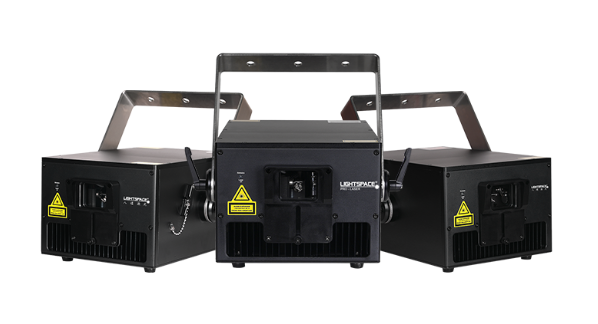
Lightspace Unicorn Series is a lightweight outdoor laser projector developed for cultural tourism and outdoor landmark applications. The whole series adopts <1.2 mrad narrow beam design, equipped with IP66 protection and dual constant-temperature anti-condensation systems. It supports long-term unattended outdoor operation, is compatible with DMX512 and Art-Net protocols, and complies with GB/T 43210 stage laser safety standards, fitting all types of cultural tourism illumination projects.
- Unicorn-30W: Total weight only 21 kg, IP66 protection. Suitable for square and building wall projection. Real urban test yields effective projection of 300–600 meters. Supports both beam shows and pattern animation, a frequently selected model for scenic night tours and outdoor music festivals.
- Unicorn-60W: Bestseller for landmark projects. Its narrow beam cuts through urban light pollution. Real rooftop landmark tests achieve visibility over 800 meters. Full-color RGB, capable of outputting beams, logos and dynamic animations.
- Unicorn-100W Ultra-Light Model: High-power lightweight chassis, solving the heavy hoisting pain point of traditional 100W units. Ideal for ultra-long-range landmarks and mountain illumination, delivering long-distance beams spanning thousands of meters on clear nights.
Common Pitfall for Engineering Clients
Focusing solely on wattage while ignoring beam quality and outdoor protection. Units with large divergence angles cannot produce clear long-distance beams even at high wattage. Models without constant-temperature anti-condensation systems suffer lens fogging in rainy seasons, which directly reduces projection range. All Lightspace outdoor models come standard with dual constant-temperature anti-condensation to ensure stable long-distance output year-round.
Outdoor Laser Projector Selection: Match Power to Application Scenarios
- Scenic parks & building wall projection (100–400 m): Prioritize 20–40W. Unicorn 30–40W offers more stable performance and sufficient image clarity.
- Urban rooftop landmarks & skyline beams (500–1200 m): Prioritize 60W. Unicorn-60W narrow beam creates iconic beams visible across the city, the mainstream option for landmark projects.
- Large cultural tourism complexes, mountain lighting & cross-area beam shows (over 1 km): Prioritize the 100W Ultra-Light Model. Unicorn-100W handles complex weather conditions for ultra-long-range projection.
- Outdoor music festivals & temporary square performances: Prioritize 30–40W. Lightweight chassis enables fast hoisting, supporting both aerial beams and stage visuals.
Four Factors to Check Besides Power When Purchasing Outdoor Laser Projectors
- Beam Divergence Angle: Look for the 1.2 mrad narrow beam specification, critical for long-distance performance.
- Ingress Protection Rating: IP66 minimum for permanent outdoor installation, with mandatory constant-temperature anti-condensation system.
- Galvo Scanner Speed: High-speed galvo scanners are required for logos, texts and animations to ensure sharp edges without trailing artifacts.
- Safety Compliance: Adopt equipment meeting GB/T 43210 safety standards to facilitate project acceptance.
Conclusion
When evaluating how many watts an outdoor laser projector needs and its projection range, power is only a basic parameter. Beam quality matters more than raw wattage, and environmental conditions determine the actual visible distance. When planning projects, do not blindly chase higher wattage. Carry out comprehensive selection based on projection distance, on-site lighting environment and installation scenarios.
Lightspace Unicorn Series covers the full power range from 20W to 100W. These lightweight outdoor units fit projects ranging from scenic wall projection to ultra-long-range urban landmarks. We also provide power calculation and customized solution services. Cultural tourism and engineering clients are welcome to make inquiries.